Abby Rubinstein
Statement
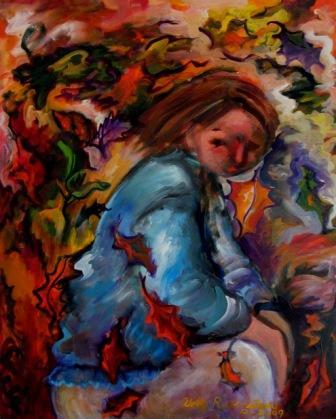
Referring to myself as an \"American Expressionist\", I find that if I need a \"label\" it is with the philosophy of the early Expressionists that I hold the greatest affinity.
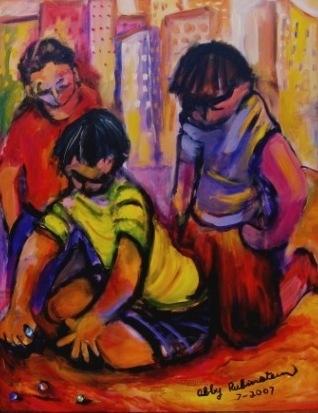
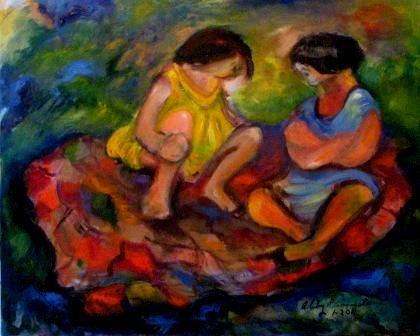
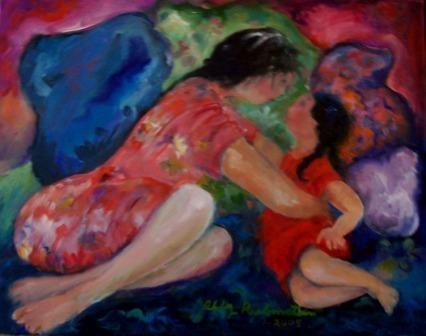
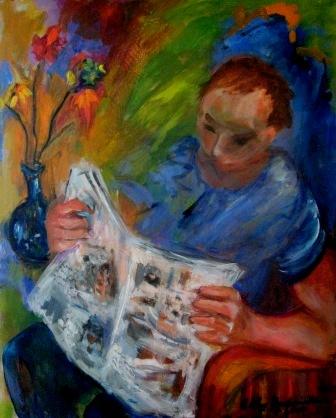
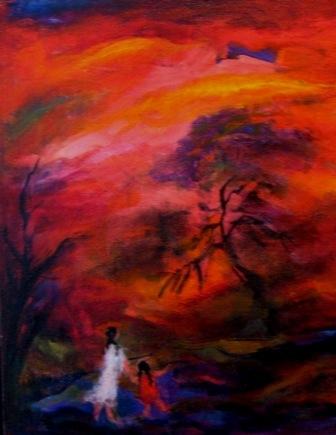
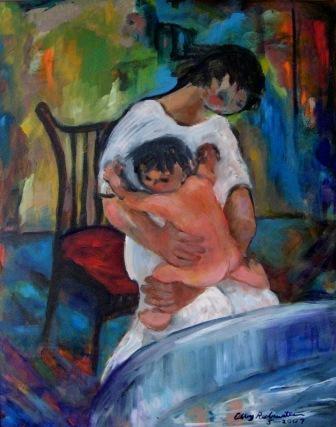
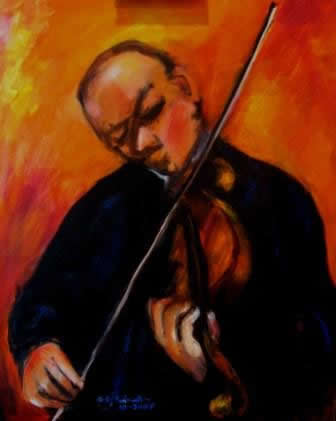
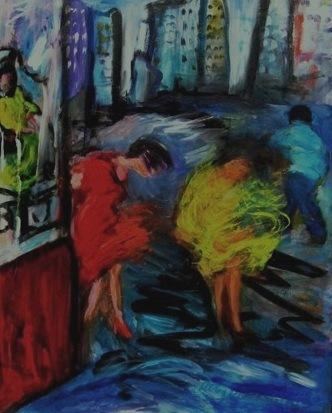
Dipping into the vast array of ideas, people, and vitality of my world, I seek a configuration or movement, color or atmosphere that corresponds with my innermost emotions. I use this as my vehicle, bending it and developing it until it speaks for me and meets others with whom it can have a conversation. I am interested in using nature, not copying it. The turn of a head, the wrinkle in a sleeve, the flip of a finger, the transition of a color to another can be unbelievably expressive of attitudes and emotions. I attempt to grasp these as I perceive them and bring them together into a moving and powerful work of art.
I believe that a true work of art transcends time barriers and that an imitative picture with nothing more exciting than correct proportions and acceptable composition will, in very short order, mean very little to anyone. But I think that a true work of art contains an indefinable element that touches a main spring of intuitive response within a viewer and effects a very intimate meeting. It\'s that intimate meeting that I seek when I paint.
I believe that if I have expressed myself adequately, the viewer is invited into the painting. This is my purpose and if I am successful then it is my achievement.
Biography
In 1943,at the age of fifteen,Abby Rubinstein began her studies at the art school of the Brooklyn Museum in New York.Having won a scholarship after her first year, she continued her studies with Rufino Tomayo, Joseph Presser, George Pippin, Francis Chris and water colorist, John Bindrum.
She also spent many hours studying the paintings at the New York Museum of Modern Art.She was moved by the color of the Impressionists and the emotions and movement of the Expressionists like Soutine, Nolde, Roualt, and Hyman Bloom.More than anything that she had learned from her formal studies, the works of these artists became of major importance to her throughout her painting career.Unaware of the labels,She was instinctively drawn to the diverse school of Expressionist painting. Over the years her philosophy became more defined until she consciously became an Expressionist painter.
At twenty-three she moved to California where she studied briefly at the Otis Art Institute and with muralist painter, Leonard Herbert. In 1966, she and her late husband, Jules Rubinstein, moved to a small pueblo in Mexico.There they painted for the next ten years and developed reputations as fine artists that brought a steady stream of international visitors and art collectors to their home and studios.
During the 1968 Olympics, they were chosen to represent the city of Guadalajara,s cultural team with an inaugural joint exhibition of their works. In nine days over three thousand people came to view this exhibition.
Works
Selected works
10 works
The record
Exhibition history
2 exhibitions